
Gas Fireplace or Gas Logs Won't Light? A Troubleshooting Guide
Posted by The Blazzing Fire Team on Nov 16th 2026
Most of the time, a gas fireplace or gas log set that won't light comes down to one of a handful of things: the gas is off, the pilot won't light, the pilot won't stay lit, or the pilot's fine but the burner won't come on. Each one points to a different part, and several are easy fixes you can check in a few minutes, like a closed valve, dead batteries or a dirty pilot. Anything that involves the gas line itself, or a smell of gas, is a job for a licensed technician.
Here's how to figure out which problem you've got.
First: Do You Smell Gas?
If you smell rotten eggs or sulfur near the fireplace, stop. Don't try to light it, don't flip light switches, and don't use your phone inside. Get everyone out, then call your gas company or 911 from outside. Natural gas and propane are odorless on their own; that smell is added on purpose so you'll notice a leak. Everything below assumes there's no gas smell.
Why Do Gas Fireplaces Act Up on the First Cold Night?
It's almost a tradition. The first real cold snap of the year hits, you grab the remote, and nothing happens. Or you hear the igniter click, click, click, and the pilot never catches.
There's usually a simple reason. The fireplace sat unused all summer. Spiders love building webs in pilot tubes. Dust settled on the pilot and the sensors. The remote batteries quietly died in July. And if someone turned the gas off at the valve last spring, there's now air sitting in the line where gas should be. None of that means your fireplace is broken. It just means it needs a little attention before it runs reliably again.
How Does a Gas Fireplace Light, Anyway?
Knowing the basic chain makes troubleshooting much easier. Most standing-pilot gas fireplaces and gas log sets work like this:
- Gas reaches the valve through your gas line and a shutoff or key valve.
- The pilot lights. You push in the control knob (or the system does it for you), gas flows to the small pilot flame, and a piezo igniter sparks it.
- The pilot heats a safety sensor. A thermocouple tells the valve, "there's a flame here, it's safe to keep gas flowing." Many systems also have a thermopile, which generates a small amount of electricity to power the main valve and remote.
- The main burner opens. When you turn the knob to ON, hit the remote or flip the wall switch, the valve sends gas to the burner, and the pilot lights it.
Vent-free gas logs add one more safety device: an oxygen depletion sensor (ODS), built into the pilot, that shuts everything off if oxygen in the room drops. Electronic-ignition systems skip the standing pilot and light on demand, which changes a few of the steps below.
When the fireplace won't light, the problem is almost always at one link in that chain.
Problem 1: The Pilot Won't Light at All
You push the knob, press the igniter, and get nothing, or clicking with no flame.
- Is the gas actually on? Check the shutoff or key valve near the fireplace; the handle should run parallel to the pipe. Make sure your other gas appliances work. On propane, check the tank level.
- Is there air in the line? After a long off-season or a gas shutoff, it can take several tries (holding the knob in for a bit each time) before gas reaches the pilot. Follow your manual's lighting steps exactly.
- Do you see a spark? Look at the pilot while you press the igniter. No spark can mean a cracked electrode, a loose igniter wire, or a gap that's too wide. On electronic ignition, start with the batteries in the receiver or battery pack.
- Is the pilot clogged? Spider webs and dust can block the tiny pilot orifice. A gentle puff of canned air around the pilot (with the gas off and everything cool) clears a lot of these. If it's packed in deeper, a technician should clean it.
Problem 2: The Pilot Lights but Goes Out When You Let Go
This is one of the most common gas fireplace problems, and it usually points to the thermocouple.
- Hold the knob longer. Most manuals say to hold it in for 30 to 60 seconds after the pilot lights so the thermocouple heats up. On a cold night, give it the full minute.
- Check that the flame hits the sensor. A healthy pilot flame should wrap around the thermocouple tip. A weak, lazy, mostly yellow pilot often means a dirty pilot, and the thermocouple doesn't get hot enough.
- Thermocouples wear out. They're a common replacement part after several years of use. If the pilot looks good and still won't hold, the thermocouple is the likely culprit.
- On vent-free logs, it could be the ODS. Dust on the ODS pilot can make it trip early. Make sure the room has good air, and have a pro clean or replace the ODS pilot. Never bypass it.
Problem 3: The Pilot Stays Lit, but the Burner Won't Come On
The pilot's glowing away, but turning on the fireplace does nothing.
- Batteries, batteries, batteries. Replace the batteries in the remote and the receiver (often a little box near the valve). This fixes more "broken" fireplaces than any other step.
- Check the knob and the switch. The control knob has to be turned from PILOT to ON before the remote or wall switch can work. Also check that the remote is set to the right mode and, if it's thermostatic, that the set temperature is above room temperature.
- Re-sync the remote. If you swapped batteries and it still won't respond, the remote may need to be re-paired to the receiver. Your remote's manual has the steps.
- The thermopile may be weak. On millivolt systems, a tired thermopile can keep a pilot lit but not make enough power to open the burner. A technician can test it with a multimeter in a few minutes.
- Loose wires at the valve can do the same thing. If you're comfortable, check that the switch wires are snug, but leave anything past that to a pro.
Problem 4: The Burner Lights, Then Shuts Off After a Few Minutes
- A weak thermocouple or thermopile can work at first and drop out once things heat up.
- Vent-free logs: the ODS may be doing its job. Crack a window, make sure nothing's blocking airflow, and if it keeps happening, call a pro.
- Vented fireplaces: some have a spill switch that cuts the gas if exhaust isn't venting properly. A blocked flue, a nest, or a closed damper on vented gas logs can trip it. Don't keep resetting it; have the venting checked.
- Logs out of place. If the logs were moved during cleaning, they can block the flame and confuse the sensors. Check your manual's log layout diagram.
Problem 5: It Lights, but the Flames Look Wrong
Tall, lazy, smoky yellow flames that leave soot on the glass or logs aren't a "won't light" problem, but they're worth fixing. Common causes are logs placed wrong, clogged burner ports or an air shutter that needs adjusting. A blue-only flame that's weak and low can mean low gas pressure. Both are jobs for a technician.
When Should You Call a Pro?
Call a licensed gas technician if you smell gas, see any damage to the gas line or valve, need to replace a valve, thermocouple, thermopile or ODS, keep tripping a safety switch, or simply aren't comfortable working near gas. Some homeowners do swap their own thermocouples, but parts have to match your exact model, and a wrong fit can create a real hazard. An annual service visit before the season is also the best way to avoid this whole guide next November.
And one nuance worth knowing: what we've described is how most systems work, but brands vary. Your owner's manual always wins, especially for lighting steps and hold times.
Want to go deeper? Our Gas Log & Burner FAQs and Burner Info & Compatibility guides explain how burners and controls fit together, Gas Log Cleaning covers keeping logs and pilots free of soot and dust, and Which Gas Fireplaces Are Legal Where You Live explains vented vs. vent-free.
Quick Troubleshooting Flowchart
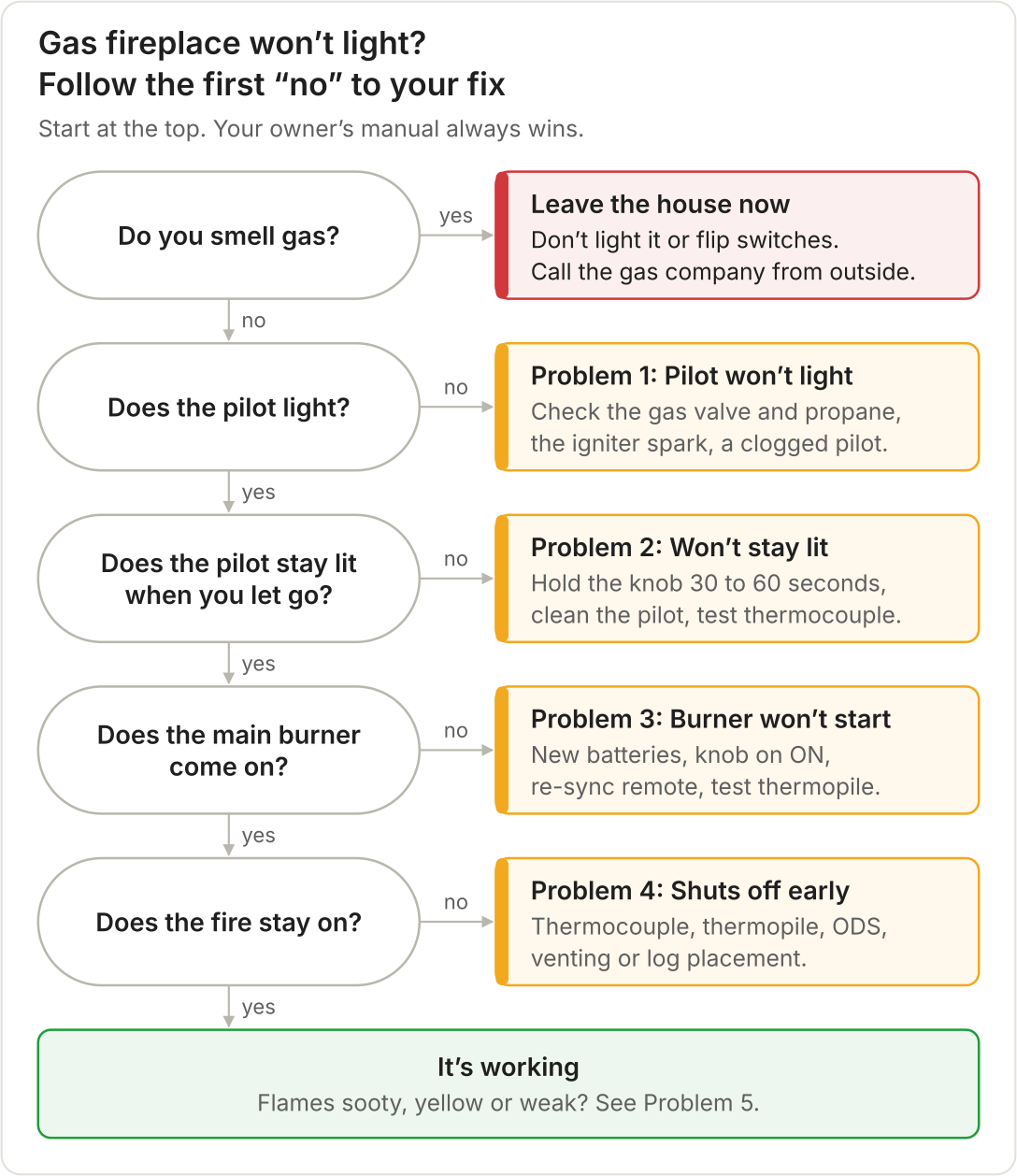
Work down from the top. The first "no" tells you which section to jump to.
Repair It or Upgrade It?
If your gas log set is old, sooty and on its second or third thermocouple, it may be time to stop chasing parts. A new burner system can mean easier lighting, a remote, and a flame that actually looks good again. If your set is a Real Fyre, these pilot kits are a common upgrade (always confirm the fit with your burner model and fuel type first):
1. Real Fyre APK-17 Low Profile Automatic Pilot Kit with Variable Flame Height
Price: $590.40
A low-profile, remote-ready safety pilot system with variable flame height. It comes with a basic transmitter and receiver, so you can turn the fire on and off and adjust the flame from the couch.
2. Real Fyre Standard Pilot Kit with Basic ON/OFF Remote
Price: $675.00
A straightforward automatic safety pilot system with a low-profile safety valve and a simple on/off remote. A good fit if you want reliable lighting without extra features.
3. Real Fyre Electronic Pilot Kit with Non-Standing Pilot (EPK)
Price: $867.60
No standing pilot at all. The system lights on demand from the remote, so there's no pilot burning gas all season, and no thermocouple to wear out. If pilot problems are what brought you here, this is worth a look.
For the gas supply side, we also carry flex gas connectors and shutoff valves, like the USD Products Gas Connector Shut Off Valve ($16.25) and whistle-free stainless connectors from about $27. These should be installed by a licensed gas pro.
Thinking about replacing the whole set? Start with our Gas Log Calculator to find the right size, then browse gas log sets or read How to Choose a Real Fyre Gas Log Set.
Need a thermocouple, thermopile or ODS pilot for a specific model? Those parts have to match your fireplace exactly, so call us with your make, model and serial number (usually on a tag near the valve) and we'll help point you to the right one.
Frequently Asked Questions
Why won't my gas fireplace pilot stay lit?
Usually the thermocouple isn't getting hot enough or is worn out. Hold the knob in for a full 30 to 60 seconds, make sure the pilot flame touches the thermocouple, and clean any dust off the pilot. If it still won't hold, the thermocouple likely needs replacing.
Why does my fireplace click but not light?
Clicking means the igniter is working. The gas may not be reaching the pilot yet (air in the line, closed valve, empty propane tank), or the pilot orifice may be clogged.
My pilot is lit, but the remote doesn't do anything. What now?
Replace the remote and receiver batteries, make sure the control knob is on ON (not PILOT), and re-sync the remote. If none of that works, the thermopile may be too weak to open the valve.
Is it safe to relight a gas fireplace pilot myself?
Yes, if there's no gas smell and you follow the lighting instructions in your manual or on the label near the valve. If you smell gas, leave and call your gas company.
Can I replace a thermocouple myself?
Some homeowners do, but it involves gas components, and the part must match your model. We recommend a licensed technician.
Should I turn my pilot off for the summer?
Many people do to save gas. Just know you may need to purge air from the line and clean the pilot when you relight it in the fall. Follow your manual.
How often should a gas fireplace be serviced?
Once a year, ideally before the cold weather starts, so problems show up in October instead of on the first freezing night.
Get Your Fire Back
There's nothing worse than a cold, quiet fireplace on the night you need it most. Blazzing Fire is an authorized dealer for every brand we sell, with full manufacturer warranties and technical support on every order, so you're never stuck figuring it out alone. Founded in 2016 by fireplace and chimney experts, our team brings over 100 years of combined industry experience. Browse gas log sets and current deals, or call 866-238-9228 and let's get your fire roaring again.